Categories
At Home With The Guy With The Hand

The Gap

I have a gap between my teeth, a new gap, one which triggers fear; to my mind it is a harbinger of doom, one of Death’s outriders heralding his master’s imminent arrival. It is not as though we’re talking a milk tooth breach here, my missing tooth was a respected tooth of long standing. Ok, maybe I’m exaggerating, but at the same time, see it from my point of view. Some gaps between your teeth are considered acceptable; some, so they say, offer the promise of a sweet singing voice. You may even, as an actor, get a career defining look with a well-placed gap, think Terry Thomas. But in my case, the only thing to emerge from my newly defined smile is a soft lisp, one which is not helpful when trying to impress strangers who happen upon my podcast. And then there is a new, devastating side effect caused by the loss of a natural tooth bridge. Constant vigilance is necessary when eating soup. One lapse in concentration and I find myself leaking; chin wet, shirt-stained levels of leak. From the outside the gap seems harmless enough, but a white shirt bears witness to the threat posed by carrot soup and a carless attitude. But this is not the worst part of losing my tooth, that must be the mental toll it has taken on me.

A man goes bald slowly, which gives him time to make his peace with the aging process. If, like me, your hairline gradually receded, you had time to, first of all, panic, then try a remedy or two, after that there was anger, which in turn was followed by grief. And by the time your scalp was as follicly challenged as an egg, there were wrinkles around your eyes, not to mention bags under them. By then, your five-o-clock shadow arrived at noon and for some reason it was grey. You hadn’t noticed that time was playing the long game and winning. It was as though the pied piper had played its seductive tune, and you had danced along in some sort of hypnotic trance. But all trances end.

Recently, I visited a dentist and despite the administration of narcotics I was dragged roaring in dismay from my trance because the procedure apparently doubled up as cataract laser surgery. Looking into the mirror to see what damage had been done by the dentist, I discovered, staring back at me, the crystal-clear image of an old man. Not ancient, old, as in OAP old, as in dribbling soup old. All of which got me thinking about teeth and gaps and horses and aging, and I got properly confused and decided to share my confusion. For the moment let’s forget all talk of death, darkness and Leonard Cohen songs, let’s start with my current dentist and work from there.

 I have a very nice dentist. Her niceness cannot be overstated least she reads this piece and takes offence; there are outstanding visits pencilled into my calendar. Having said that, it is funny how quickly a person bonds with someone who shoves power tools into their mouth, it doesn’t seem to matter that conversation between you is a mite one sided, you bond. You need them to love you. After all, they have the deciding vote on just how much anaesthetic gets administered during deep cleaning, deeper fillings and (God help you if you need this,) root canal. Let’s just say, my generation has a very jaundiced view of the profession. We were not delivered by eager parents to the altar of the dental sciences at the age of two. We were rough and tumble, nappy-trained rascals by the time we arrived in a waiting room. We had all shed our milk teeth and been paid off by the tooth fairy well before the health board rustled us up and delivered us to a dentist’s chair.

We were all past our Santa years by then. We were past holy communion and well on our way to confirmation. We knew about pain and suffering and Satan, and from the bigger boys we were learning about, among other things, dentists. Drills, needles and blood were mentioned in the same sentence. “He’s a rough one,” was the verdict on one dentist, “She’s worse than Satan himself,” the verdict on another. But the bigger boys were nothing compared to grandparents and old men on the street. An eggcup of whiskey for the pain, one veteran suggested, talking about the proper procedure for tooth extraction. Then all you needed was string, a heavy door and a good, strong door handle.

Dental visits were talked up into nightmare scenarios. Not that people died – at least that we knew of. We relished talking about pain, kids are ghoulish, the Irish more ghoulish still. And we were a traumatized country in a time when post traumatic stress was not treatable. The ailment seemed to be as common as the commonest of colds. I’m not blaming anyone for this; we were surrounded by people who had survived both the church and the state. Memories of the civil war were still fresh. Veterans of two world wars were shunned. Families decimated by TB were emotionally crippled. Polio survivors limped here and there, dead arms taped to their chests. The elephant in the room was poverty. It was everywhere. You could see it in carefully patched jacket sleeves, or gaps in the mouths of strangers. Poverty had a smell to it too, a smoke-stained smell mingled with stale sweat with a hint of desperation. But we were Irish, made up equally of pride and shame. We sang loud ballads to drown out the wailing sound of banshees at night and the bleatings of parish priests in the morning. We also danced to keep our spirits high and joked to keep our daemons at bay. In a world like this, dentists might be scary, but a lack of them was scarier yet.

My first dentist visit got me time off school, so I had lunch at home and strolled off, unaccompanied, to investigate what all the fuss was about. Say one thing about kids back then, we were raised to be independent. Truth be told, the whole experience was a bit of a letdown, one which left me cold. There were no cries of agony from fellow patients, no emergency crews carted half-dead kids from the dentist’s chair to an operating theatre in the adjoining hospital for life saving surgery. The only thing of note was me punching the dentist for insulting my father. He evidently knew him. Anyhows, he found my antics comic, judging by his big-bellied laugh, and found my mouth in no need of his talents. As I say, to the eyes of my eleven-year-old self, this was no Huckelberry Finn adventure.

Other people fared much worse than I did in the dentist’s chair. Driven by fear and suspicion, and raised in a culture where fairies stole babies, and banshees announced death, many people warded off the threat of tooth decay in the most peculiar of fashions. I remember a young bride proudly flashing bright new dentures as she walked down the aisle. They were a wedding present from her parents, a way of stopping teeth rotting in her head and putting a halt to tooth loss during pregnancy.

All around me growing up prematurely old men abounded. They hung around bookie shops on the street, cigarettes smouldering between their lips, or waited, shoulders hunched, for pubs to open. Most of their mouths bore signs of neglect. Their smiles were ready, sure enough. But what they exposed were the worst elements of poverty and neglect. The gaps between their teeth were large and pronounced as they joked among themselves. They were not as lucky as my generation of friends, ones who were brave enough to hurl at even the most basic of level. For them a broken jaw was a rite of passage, tooth loss a given, dentures a disguise to cover their loss. But for me, dentures, a tooth bridge, whatever you want to call it, is a prosthesis by another name. An arm you can hang up in your closet and teeth which spend the night in a glass are one and the same thing to my mind. Ok, so a hand doesn’t smile or chomp your food, but somehow, for someone who wore a prosthesis for years, the difference in minimal, the separation of hand and mouth impossible. I might as well ware a wig in an effort to deny hair loss. And yet… Looking in a mirror, I am reminded of broken old men with vacancies in their mouth and the vacillation begins. Remember my latest dentist would like to plug the gap. And she is a very persuasive woman, not to mention very efficient with power tools; ones far more refined than those littering the middle aisles of Lidl.       

Categories
At Home With The Guy With The Hand

Respite

AI generated image

There are parallel universes all around us, ones never mentioned by science fiction writers, investigated by journalists, given credence to by alien followers, or any real consideration by most of us, most of the time. However, whenever we use the word, ‘they,’ we are effectively admitting that these universes, ones almost completely beyond our ken, exist. ‘They,’ it seems, can cover a multitude of worlds from which we are barred, ones we may once have belonged to, and ones we would rather forget we were ever part of. ‘They,’ covers any group we are currently not members of. Students, they. Children, they. Teenagers, they!!! And the mere use of the word bankers can sound like an expletive when followed with the word they. Mind you, that can be said of many professions or groups of people. The elderly are one such group, one most of us would rather not be bracketed with.

However, it will be the last separate world, in a world of worlds, that we will all belong to, and that, only if we get lucky. Everyone strives to live forever, without considering what it means. It means being elderly for a very long time. It entails coping with cataracts and prostates, hearing aids and walking sticks, weakness and memory loss. And somewhere along the way, medics start to whisper instead of talk to you and people start to use we when they mean you. Then of course, food doesn’t taste as good as it used to, films aren’t what they once were, and technology is built to confuse rather than to help.

You may feel smug because you can turn an a laptop, but when your hearing deteriorates to the point that Siri’s answers go unheard, that feeling shall shatter like a Waterford crystal vase meeting a ceramic tile, quickly followed by panic greater than that of a vegan failing to persuade a hungry lion to try out the vegetarian option on today’s menu.

Sometimes, no matter how we try to avoid it, we find ourselves, like ET, stranded in a universe we were only vaguely aware existed minutes earlier. In my case, this other universe, one surprisingly close to home, was respite. It took a plumbing crisis to trigger my warp speed journey to this unknown land. Suddenly, pipes which should remain hidden, were overground, like snakes they laid siege to the house, holes abounded in the drive and the only access to the front door was via a temporary bridge made of MDF. Plotting with the plumber to fix the problem, it became obvious that trenches would have to be dug, paths cut into, and walls drilled through. In short, we were talking a level of chaos which no 95-year-old would tolerate. Calls were made, advice sought, and a solution offered. Not that my mother was happy with the solution, but she ultimately agreed when it was confirmed that if she took respite, she could have a glass of Prosecco in the evenings and have wine with her dinner. During the negotiations I felt like a parent offering bribes to persuade a reluctant child walk through the school gates on its first day.

Once the principle had been sold, however, the system kicked in; the whispering form-fillers lined up behind each, like planes waiting to land at Newark, and ordeal by bureaucrat had begun. My mother, aware that any wrong answer might give a wrong impression, that her mind was in a state of collapse, was more than usually helpful. For once she did not lie about her age, unlike last year when we were in a supermarket where she told a woman that she was eighty. Bloody rude of her to ask, she remarked, as we walked away from the inquisitor. Now she told the truth, but sparingly. Date of birth, she would answer. But as for the follow up question of how old she was, she would reply, do the maths. Have you been hospitalized recently? was a dangerous question. It gave Ma reason to vent, taking out a flame thrower to the reputation of a doctor who once sent her to A&E for a better quality of life. I spent 12 hours sitting on a hard chair waiting to see a doctor, when all I needed was a course of antibiotics, she would begin. He asked me why I was there and when I told him he shrugged, and shook his head, and said, ‘GPs,’ as though they were all village idiots. Then he gave me the antibiotics she had refused me. A better quality of life indeed.

No matter how much experience you have, and I have seen my mother asked this question a dozen times, there is no easy way to ask it. In case of emergency, do you wish to be resuscitated? My mother’s reply usually goes like this, I’ll tell you what I told that doctor in A&E last year, I’m happy enough not to be resuscitated, so long as you’re not actively trying to put me down. The reply puts many a health professional on the back foot. This is often the case with the elderly, at some point they get fed up playing other people’s games. I remember an old woman, who when a young doctor came to her bedside to explain what was wrong with her, said to him, young man, don’t tell me how I’m doing, you know nothing about it, while I practically have a degree in dying.

Forms filled in, follow up telephone calls taken, the day finally arrived. It fell to me to guide my mother through the admissions process. No worries there I thought, we had the equivalent of pre-clearance. Not so. What should have been a two-minute process became a two-hour process. First one nurse, then a second questioned my mother’s prescription. We had cleared that hurdle already, or so I thought when the form fillers had done their best to understand my mother’s particular needs. However, it now seemed that the form fillers had not passed on their findings and as a result my mother’s doctor was being accused of malpractice and me of drug pushing. My mother sat on her bed, completely oblivious to the charges against me, because she was not wearing her hearing aids. I kept bating back objections, grateful to my sister, a nurse, for having explained the meds to me in such tedious detail. At one point the nurse read a remark in the doctor’s report, then pointed to the bed and asked, does she know? Ask her, I replied. One thing is certain, my mother knows more than she pretends to, though she does choose to interpret the facts as she would like them to be. Who doesn’t? the nurse didn’t pursue the doctor’s report with my mother, but she did ask her about hospital admissions; a mistake, as she got a lecture about doctors all being afraid of their own shadows, about the quality of life in A&E departments, and about the wonder of antibiotics. As for being resuscitated… She had her response down pat for that question

I eventually escaped, but my mind was troubled as I drove away. Thinking about them, not the elderly, the medics; there was something about the place which reminded me of The Mad Hatter’s Tea Party. It induced a feeling of mental quicksand; nothing these reassuring professionals half-whispered resonated with the universe I normally inhabit. They seemed obsessed with paperwork and procedures, but no one thought it odd that an assistant wrote blood pressure reading on a piece of kitchen towel, instead of on an actual page, with the patient’s name writ large, in a prominent place. Having said that, everybody was extremely kind, and my mother knows how to hold her own in any get down-and-dirty argument, so I had no real qualms leaving once the paperwork was done.

As the respite was not for me, but my sister, I felt free to drop extra Prosecco supplies behind enemy lines during her stay. On the morning of my visit, I discovered her arguing with a nurse as I rattled into her room. She was explaining to the young woman, as though she was an idiot, that a cough bottle was not a prescription drug, therefore she could take it whenever she chose to, so open the safe and uncork the bottle. The nurse tried explaining the restrictions on usage of an expectorant but was getting nowhere with her elderly patient, who all the while was waving an unlit cigar about as she pressed home her point.

I had once tried explaining that she shouldn’t take the expectorant before going to bed, as she would wind up coughing all night, only to watch her defiantly reach for the bottle. So it was no surprise when the nurse yielded, and a tiny cup of the mixture was poured as precisely as whiskey from an optic, the liquid was drunk by the victor, and we headed for the great outdoors, so that my mother could smoke her cigar. The journey involved a few near hit-and-runs with the walking aid, as the place was infested with students from a nearby school who were getting acquainted with the wrinkled, determined faces bearing the scars of longevity. Ma’s victory was somewhat muted when we hit escape velocity and landed out in a sun-drenched patio area. Her smoking buddy had been taken hostage by the school kids, and she always brought matches to the meeting. She keeps them in her handbag, my mother told me, but she always forgets where they are until I remind her. There are matches in the oratory, she continued, they use them to light the candles.

Puffing out a cloud of smoke, my mother handed back the matches for me to return to the oratory as I left. On my way out, a nurse stopped to chat for a moment. She’d show you how to live, your mother, she whispered in admiration.            

Categories
At Home With The Guy With The Hand

Last Rites

AI generated cover picture

Sometimes I wake up with a start in the middle of the night and feel like a man facing into the stereophonic depths of a double-barreled shotgun. It seems as though the grim Reaper is standing at the foot of the bed, a deadly weapon’s stock firmly placed against his shoulder, a boney finger on the trigger. We can argue about Death’s form all we like, a skeletal figure carrying a scythe is comfortingly familiar, candles in eye sockets can be added as an optional extra, if you find that reassuring. For others, Death may be a raven-haired beauty with pale skin, blood red lips and a cold, cold touch; why not, if a date with this heart stopping femme fatale appeals. I’ve also heard talk of golden-haired children reaching out to take your hand and guide you to the promised land as your last breath leaves your body, evidently this figure has special meaning for those who summon him, but in this day and age I would be arrested for taking the hand of any child who was not mine, no matter how lost it was. As for me, my grim reaper is currently more of a modern-day brigand than anything else. I imagine him as being overweight, a tracksuit wearing thug with 125 previous convictions; a man who gets a Christmas card every year from a barrister whose kids are slowly working their way through college, paid for by the state’s free legal aid fund. My Death reeks of criminality, and I have no intention of going anywhere with him just yet. As nightmares go, he is just scary enough to wake me up at the witching hour in a deep state of funk, but not so frightening that he can still my beating heart.

I have woken up, sweat pumping, heart pounding a frantic tattoo in the middle of the night, for as long as I can remember. But oddly enough my memory only goes back to a time when I was seven, a time when preparations for my first holy communion began in earnest, a time when the concept of heaven and hell were introduced, a time when being bold became committing a sin. Being bold is one thing, and not a terribly bad thing at that. But committing a sin, spray painting a black mark on the soul with each venial thought, this is when the rubber hits the road, because suddenly I had a soul, one rapidly turning grey by the sounds of it, if not already turning into a Farrow & Ball off-black, possibly called Satan’s Stamp. Suddenly, my soul, something I had only recently acquired, was in mortal danger, bound for eternal damnation. Is it any wonder that I was suddenly waking up covered in sweat in the middle of the night, frozen in panic, ready to confess to every mortal sin under the sun, including that of coveting my neighbour’s wife. I was vague about what that might be, but I was ready to confess to it, so long as my confessor played his part, absolved me, and threw my soul into a hot wash which would restore its pristine-white glory once more. So, by seven, a joyous, free-flying soul had become grounded by the leaden weight of guilt; and my nights had become a torture chamber of sorts. Thankfully, I had the concentration span of a newt, so my soul and I had manys-a-good-time, despite my newfound sense of moral austerity.  

What nobody explained back then, nuns can be very lax about the proper education of their charges, was, that with a little bribery and corruption, a cleric could guarantee a soul-cleansing service that reset the soul to a post-baptism font level of purity. One, it seems, does not have to return to the Middle Ages to buy one’s way into heaven, as my mother demonstrated recently.

Her generation was not one which believed in sharing their secrets, or demons, with anybody except their most intimate friends. Personal tragedies were locked away, buried deep from strangers. Joys were suppressed, in case the fairies got to hear about them and decided to put a stop to them, or some gossip embellished the details of your life until they bore no semblance to the truth, while simultaneously destroying your reputation. Gossips and trolls have always existed, always will. It’s part of what makes us human, this envy of those who walk their own path, this urge to punish those not of their tribe.

My parents’ generation grew up cautious as a way of protecting themselves from their most tribal of neighbours. Their adage, ‘Never talk politics or religion with strangers,’ was partly good manners and partly self-protection. Not that it took a genius to know your least guarded secrets. Anyone could tell your politics by the newspaper you read; your beliefs, by the church you attended; your secret life, by the books you borrowed from the library; and your moral laxity, by the clothes you wore.

As for religion, there was a ninety percent chance that you were a Roman Catholic; part of the majority; and it is always safer to hang with the majority. However, public opinion is a fickle thing. Today’s mainstream religion is tomorrow’s myth, or new age hankering back to Druidic idyll, without the human sacrifice of course. While many people are dismissive of the Roman Catholic church, over two million Irish people attend mass on a regular basis. For me, the church’s dwelling on suffering and sin is a mite heavy-handed, and the modern translation of the bible lacks poetry. However, to others, it offers direction and solace; something I would never deny to anybody.

As I said, my mother’s generation was all about subtext. Conversations with my mother are sometimes twisted and torturous, and the point so far below the surface that it might as well be hidden under the wreck of the Titanic. When she began talking about a church visit, to light a candle, and possibly save American democracy, my curiosity was piqued, but not overly so. St. Teresa gets my mother’s penny, and it was to her shrine on a side aisle that we traipsed, coins in hand, laden down with good intentions. Children were being baptised at the main alter, diversity very much on show at the water font. While a senior cleric was busy renouncing Satan on behalf of these harmless looking infants, various minor clerics roamed the church.

With three candles ablaze, and good intentions prayed for, my mother’s real intention became clear. She was here to nab a priest, one who featured regularly in her conversations at home, a young man who ruined his good looks by growing a beard without her permission. Nabbed and unable to escape, the cleric agreed to meet her at the community centre a few days later. The penny was beginning to drop.

Armed with backup from my sister we turned up for the appointment. The priest was busy, busy, busy. My mother, grimly determined. He did not have a chance. It was too late to feign another engagement, he was trapped and my mother finally revealed what she wanted from him. Extreme Unction. We can argue all we like about language, about the rebranding of this sacrament as the anointing of the sick, but there is no hiding from the fact that as sacraments go, this one is a kicker. There is no disguising what it is about. It is the last rites; the last chance to bleach the soul clean of its sinful past, to polish off minor scratches and pass it off as a one-lady-owner soul to the great car dealer in the sky. As kids we equated it with emergency first aid for the soul. Along with a perfect act of contrition, we were told, that it was like baptism for the old, a sure way of getting through the pearly gates. I suppose it was the equivalent of a Vaseline-smeared rich man being pushed through the eye of a needle. The sacrament was properly ghoulish, associated in our minds with death rattles and priests whispering code words in the ear of the dying; for although anybody could administer an emergency baptism, only priests carried the sacred oil required for this sacrament.

We removed ourselves from the community center to the church to get our hands on these restricted items. The priest looked as though he would prefer to be anywhere but where he was. Still, he muttered his words, absolved all my mother’s sins and wrapped the sacrament up with unnecessary efficiency. The cleric was about to beat a hasty retreat from this ninety-four-year-old, no doubt wondering how she had got him to a secondary scene of the crime in the first place; wondering how she had so out-manoeuvred him. Not old enough to know yet that planning, willpower, and a surprise attack always has the advantage over the unprepared. And now his hand had been gripped, and very old, blue eyes were focused on him. Her lips were moving, his mind was elsewhere.

“What?” He asked.

“You will remember me?” she repeated. “You will remember me father?”

“Well…” he stammered, “I’m… There… There are so many…”

“You will remember me,” she persisted, “Won’t you father?”

He looked down to see a fifty euro note in his hands.

“You will remember me?” she asked again.

“Of course I will Mary.”

Moments later, we emerged from the church, into the light.

“Now I can commit any sins I want,” declared my mother, “They have already been washed away.”

She knows this is not how general absolution works but fondly remembers a man who rebuked a priest who once tried to persuade him to take confession.

“I was given general absolution before going over the top of the trenches in the first world war. A man doesn’t need any more absolution than that.”

“No, no,” insisted the priest, “That’s not how it works.”

“What would you know about it father?” came the quick reply, “Was you ever at Mons?”

I wondered, as my mother was being loaded into the car ,what sins she was planning to commit? Driving? (A vanity at 94.) Or maybe lampooning politicians, though that hardly counts as a sin. After all, they don’t have a good name to begin with, so they don’t have a reputation to ruin.

There is her gambling habit, I suppose, at least according to my aunt. Others may think she is a wanton woman, the way she flirts with the fish man, but that is more about securing fresh hake and a good racing tip, than any improper intentions. As for the scratch cards my mother can occasionally be seen buying at a local newsagent, they are merely a cover for what she is really buying, cigars. Not that she has ever admitted to a doctor that she smokes. But then, what is one cigar a day? Hardly a habit, more of a hobby, a thinking aid when she’s standing up to her crossword outside at the bin, a fresh coffee off to one side.

Yet, as she stands at the doorstep, blowing smoke out the back door, I wonder how she really feels about death. There is no point in expecting her to tell me. Her generation were not built to share their darkest secrets. But if my nightmares are anything to go by, hers must be scarier still, but hopefully, not heart stopping. At least not yet. There are still plenty of cigars hidden in a drawer, waiting to be smoked. And the neighbour’s have been summoned for a little get together. Remember too that, judging by one man’s experience, Last Rites can proceed death by over forty years. There’s a thought, no wonder my mother sent me down for a Euro Dreams ticket today. That draw pays out over a thirty-year period. What does she know that I’m not aware of yet?

Categories
At Home With The Guy With The Hand

The Situation Room

Even as Trump forms a committee to Steal America’s Future, Again, (SAFA,) my mother has summoned a council of war to oppose him. While he may have a monstrous regiment of billionaires and bullies, she has only me. In truth, my position is a lowly one, that of a springboard, a listener to political editorials, half-written letters of protest and, lately, I’ve become her poetry critic.

Not being up on satirical poetry, or indeed poetry in general, you might think that recruiting me to her team was a huge mistake, and you would be right; but needs must: even if I am to poetry, what lead is to flight.

Hearing the first lines of The Daffodils still causes me to fall into a post traumatic state; sweat breaks out, I’m ten-years-old again, head down on my desk as verbal shrapnel flies overhead, spewed like molten lava from my teacher’s mouth. Suddenly, my heart needs a defibrillator to kick-start it back into action, and a pacemaker is required to steady its erratic beat. I fared better with Ode to a Nightingale, suicide contemplation, even in poetry, seemed cool during my slouching teens, it was something my darker self could at least understand. The fact that a poet had accidentally touched my imagination seemed ironic to me, but these are some the contradictions in life that one must learn to live with, I reckoned. Shakespeare had one or two grim sonnets which also appealed to my teenage self, even if the rhyming scheme passed me by.

“No longer mourn for me when I am dead…” What a first line! Way to go, Willy.

Wonder how he would fare with a limerick about Trump. You see, limericks are my mother’s chosen form of poetry, her weapon of choice when it comes to dealing with this would-be tyrant.

What SNL failed to do over four years using satire, and what CNN failed to achieve with reasoned argument, my mother aims to do using the humble Limerick. Unseating a sitting president is never easy, but a well-aimed Limerick, she reckons, can do more harm to his seat of power than a direct hit from a ballistic missile on his new forever home, the White House. However, right from the get-go there is a problem. Try rhyming the word orange with anything vaguely derogatory, or anything at all, and you will see where the issue lies. Thus skin-tone comparisons are immediately off the table. To have such a soft target already closed off to us is like losing the first battle. One can already feel the whole globe shake under the weight of tanks on the move. So, where does that leave us? What frantic whispering can be heard coming from the direction of the situation room?

Traditionally limericks are hard-hitting, filthy poems, shared between men at the bar. Normally, the first line includes a person and where they hail from. A policeman from Limerick Junction, for instance. But what about him? That’s when things get tricky. The politically correct police would be on my tail if I were to say more about this flatfoot’s condition. Let’s just say that it’s not complementary and it concludes with the line, by the judicious use of his truncheon. As you will understand, the last line, the punch line, should be cringe worthy in content and the rhyming is allowed to go very awry if needed.

So far, all this non-poet has learned about limericks is that they go roughly like this.

Di doodly doodly doo doo

Di doodly doodly doo doo,

Di doodly Doo,

Di doodly Doo,

Di doodly doodly doo doo.

So far so good. All we need is a good first line and we’re off. The problem, however, is that at first my mother could only equate the future president with Donald Duck. Her first stab at a limerick gave us this first line, ‘When the US elected a duck.’ There can be only one way to finish this limerick, one last word is begging to be used, and it begins with the letter F.

Here is an example of my mother’s writing style. She wrote this limerick, and shared it with me while we mulled over the F word situation.

When they made the wolf whistle a crime

Which engendered a terrible fine

If you think it’s a joke

You can’t really be woke

Or maybe you’re just asinine

My mother, after reciting her limerick and giving some further thought to the Donald project, had a couple of glasses of wine before deciding that the word which rhymed best with duck was too arty an ending for her likes, so she turned to a new line of attack.

His supreme orangeness now seemed to offer my mother an enormous target until I pointed out that the only word which it rhymed with was sporange; a sort of sex sack for fungi, a cell filled with spores. While Trump might be easily confused with a giant orange fungal scrotum, drawing people’s attention to this fact might put people permanently off their food. However, this was not the reason my mother dropped orange from her limerick arsenal, it was the thought of finding a word which might rhyme with sporange. 

The following was a peace offering on my part as I seemed to have turned from a springboard into a wet blanket out to smother the flame of inspiration. My efforts were immediately rejected as being too clean, not satirical enough, and off brand.

There was a man on the edge of senility,

Who disdained every form of civility,

His wives were all foreign,

His sons very common,

And his brain was devoid of activity.

My mother had a point, so I had another go, shoehorning the word orange into this limerick.

When the electorate went for orange hair

The Vance ticket completed the pair

With chaos in mind

And his massive behind

All his allies he drove to despair

However, this again failed to impress. I was told that it lacked branding and was not very funny. The name, the towers, the Kitch were all missing. And they all had so much you could ridicule. We compromised to arrive at this…

When MAGA went out voting for Trump

Like lemmings getting ready to jump

Their minds were confused

And religious zeal oozed

And their orange Buddha gave us the hump

So much for branding. Not exactly an inspiring success. Having failed thus far, we revisited the duck motif with a view to keeping it clean. Can any fun come from such a thought? Possibly not.

When America elected a duck,

His bestie was known as a schmuck,

This rich billionaire,

Who jumped high in the air,

Was soon deemed China’s best luck

With such poor results we have decided to retire from the battlefield for now. If only Edward Lear was around to inspire us to greater effort on the nonsense front, but alas he is not. That does not mean that my mother is putting away her writing pad. She can still be seen walking around the sitting room, muttering half-heard limericks to herself. With any luck, inspirational lightening will strike, and Duck Ala Orange will give way to a limerick of the first order. We can only hope. However, if anybody has a limerick on White House affairs they need to share, please do.

Categories
At Home With The Guy With The Hand

A Non-Covid Event

There were times when I thought that I would never get to write this blog. It was as though I were part of a crazy, Marx brothers’ movie these last few weeks, with me in perpetual prat-fall mode, a puppet, with no control over the sadistic puppeteer who was pulling its strings; all of this when my life seemed to have stabilized a little, to be hinting at a safe harbor just within reach. Then Covid struck, sort of, well depending on whom you ask.

But before that happened…

My sister Moya was here at the time, aiding and abetting me with my mother. Between us schedules were drawn up, dinners made, shopping done, and doctor’s appointments kept. Anybody my age knows the routine. Where once my generation talked of Leaving Certs, College courses, Career advancement, friends’ weddings, kids, and dogs, and mortgages, we now explore the process of aging. Not ours of course, that would be ridiculous. You see, for many of us, our parents have become our charges, and, for a while at least, this role defines us. In a way we are rather like young mothers in a toddlers’ group talking about their smiling, burping burdens of joy. Only where teeth and potty training are discussed with pride in a mothers’ group… Well, we discuss those too, only without the pride and we follow up with remarks about cataracts, kidney function, mental robustness and the curse of cheap hearing aids. And where we might share a young mother’s sleep deprivation, ours is not caused by teething, or other physical issues. It is generally caused by nightmares, where, perhaps, we might find ourselves contestants on The Chase; a quiz show which seems perfectly harmless until watched four hours a day, for months on end. And in these dreams, we are alone, on stage, staring up at The Governess, who is as grim and plump as any Victorian, hospital matron Dickens could have conjured up to freeze the blood in the veins of his readers. If lucky, we wake up before we are asked a tough question on Greek Mythology, or a simple question on bunions. By comparison, what mental harm can come from the kids’ song, ‘And the Wheels on the Bus go Round and Round,’ played, non-stop for three or four months, or until the child loses interest.

And all the while, as this role reversal continues, there is a sad and horrifying thought never far from the surface. How long have I got before I join the ranks of the terribly old? If I ever get that far.

If I were to pick a moment when things began to go wrong, I would say it was when my sister Moya, a nurse, took my mother’s temperature and reported that she had a very high fever. That was not a serenity-inducing moment as this is Ireland, where hens’ teeth are easier to find than a hospital bed, especially on a Friday afternoon.

From there, it was anything but a hop skip and jump before my mother was admitted to hospital. The 5-bed ward was filled to bursting point with life, hospitals are weird that way. Drips hung beside three beds, a fourth patient carried an oxygen bottle with her everywhere she went, and a heart monitor regularly accompanied another patient to and from the smoking area outside. There were guests galore, and chat aplenty. The only thing missing, it seemed to me, were masks. Thankfully, with or without them, my mother was soon on the mend. She was discharged on a Tuesday, and it seemed that we could finally relax, not worry about visiting hours, spare nighties, or emergency sweet supplies. Only there was no time to relax, because by Wednesday my sister and I were complaining about hay fever but, when we tested on Thursday, our hay-fever turned out to be Covid.

We would have tested my mother too, but she refused, she is not a fan of having cotton buds shoved up her nose. However, there was more to her resistance than first appeared, and it was only later that we realized her refusal to be tested was in fact a tactical decision. So, my sister and I suffered our way through Covid, testing regularly until we got the all-clear. Our mother, however, slept. There was nothing wrong with her, you understand, she just needed to sleep. And she needed to sleep, night and day, for the best part of a working-week.

Moya and I were clear of the virus quickly enough, but it took weeks before the final stay-behind policy of the virus left us. Meanwhile, visitors and medical professionals began turning up to see my mother again. This is when we finally realized why my mother refused to be tested. As each person came and went, she would tell them all, “Moya and Jim got Covid.”

“Really?” they would ask, “And what about you?”

“Oh, no, no,” she would shake her head, “I didn’t get it.”

And she would smile, the smug smile of a strong man watching a weak one struggling under a load he himself could carry without any trouble. A Mona Lisa smile, hinting at a genetic advantage she had somehow failed to pass on to her own children. A reminder to us that behind the façade of old age ticks the calculating mind of a chess master. And if you think I’m fanciful here, you should have watched her eyes flash in our direction every time she repeated the words, “Oh, no, no. I didn’t get Covid.”

Covid is no longer novel, but it is still here. Of course, you have to test before you can prove this fact. Jim Clarken’s mother is not a fan of being tested.
Categories
At Home With Memories and Reflections The Guy With The Hand

Sharing Your Thoughts

My mother has gotten to the stage in life where she freely shares her opinions about everything, with anybody close enough to hear whatever is on her mind. In the past she might have recognised a likeminded friend in a crowd before whispering a discreet observation, one which would have caused many people’s eyebrows to buckle upwards in surprise, if heard. Nowadays, however, she shares her every thought with everybody she meets, having with no consideration for the ears her words might fall into. Sailing under the flag of old age, you see, she feels she is immune from any form of censure and revels in the freedom it affords her. For instance, Billy, our newsagent, must regularly listen my mother’s views on his beard; not to mention her sage advice. ‘Lose it, otherwise, you’ll look like something out of the Taliban,’ She gives him the same advice whenever she steps into the shop to hunt down a mass card, or a scratch card, or maybe even a cigar, depending on her needs. ‘And what would your mother have to say on the subject?’ she asks.

She usually continues her criticism of beards, at this point, by drawing a comparison between his beard and that of a local priest who has only recently sprouted a, ‘dark, hedge-like monstrosity.’ ‘I told him it ruins his good looks.’ She explains to Billy, ‘And it’s not as though he is a weak-chinned wonder who has something shameful that needs hiding beneath a blanket of hair.’ This outpouring of beard aversion is especially interesting to me as in all the thirty years I cultivated one, she never once seemed to notice the thing. Only now, since its disappearance, has she become such an open critic of facial hair.

A few years ago, such talk was limited to the breakfast table, where I got to listen to her thoughts on modern fashion trends over brown bread and marmalade, but lately she is taking her opinions to the streets and freely airing them with anyone standing before her.

Where in the past, she has always been a political animal, she could be relied on to save her most savage comments for Trump, or Boris Johnson, Isis, or Putin, these days any conversational filters she may once have had have been cast aside, and her field of criticism has expanded greatly. However, I must say that she saves her best work for the medical profession. The young doctor who refused to give her antibiotics on demand, either has asbestos for ears, or his ears are as misshapen as a retired rugby international’s due to the over-heating caused by been talked about behind his back. Another doctor, who shouted across a crowded waiting room that, ‘I’m sorry to hear your bad news,’ comes in a close second on her doctors’ verbal hit-list, but as for the doctor who sent her to A&E, to, ‘Improve her ‘Quality of life…’ Or the one who denied her a wheelchair parking permit at 93 years old… In the past my mother would have been angry when faced with what she saw as unprofessionalism, but in her new, post-filter-world, she likes to share her thoughts on the subject with any medic unfortunate enough to be sitting in front of her for over thirty seconds.

While an all-out-war with the medical profession may be justified, my mother now seems intent to tell the truth at all times, on all subjects, when in the past she might have played dumb. For instance, at the recent viewing of a neighbour, my mother pushed her way through mourners to the grieving sons, ignored the coffin, and told the eldest son that she expected him to turn up for her wake, which can’t be far away now. As shock therapy goes, it worked a treat. The red-faced stammering, chief mourner could do nothing but watch, slack-jawed, as my mother dodged her way around the milling crowd and made a fast getaway.

At another viewing, my mother enjoyed a reunion with people we had not met in an age as we waited outside to pay our respects to a ninety-year-old teacher who worked with my father for years. When my mother eventually met Mary’s brother and sister, people she had never met before, she regaled them, as she stood beside the coffin, with stories of the deceased. The retired teacher had been a non-drinker all her life. As a drinker herself, this concept was foreign territory as far as my mother was concerned. However, with Mary’s corpse practically nudging her in the back, playing the role of silent witness, my mother entertained the family with a story which the deceased had chosen not to share with her family in the intervening 45 years. Presumably, she had her reasons. Soon however, her family discovered that Mary had once accompanied my mother to a pub quiz, helped her raise funds for a good cause, and promptly sat down at the piano to provide music for the singsong which followed. However, the singalong began after hours, which was illegal. My mother’s stamina gave out at about one in the morning, so she left Mary at the keys of the piano and headed home. This is why my mother did not have her name taken by a Garda who raided the pub minutes after she had left the premises. Mary was less fortunate; and her name went into his little black book. Mary’s brother, looking almost as old as his sister, became intrigued and began an interrogation of my mother beside the coffin, causing a traffic jam among the mourners in Ma’s wake. With no hard shoulder to step into, nobody was getting past the coffin until my mother told her story. It was a triumphant woman who stepped into the night a few minutes later saying, ‘Imagine, she never told them.’ She simply could not understand how Mary had never told the story against herself. It was a good one after all, and a good story should always be shared with those around you. As should any thought which enters your head, it seems. After a lifetime of being discreet, my mother appears to have concluded that sharing your thoughts is always better than being miserly with them. And, as she is always right, what harm can come of it? Thank God she doesn’t use social media to share her thoughts with the rest of the world.

Categories
At Home With The Writer's Desk

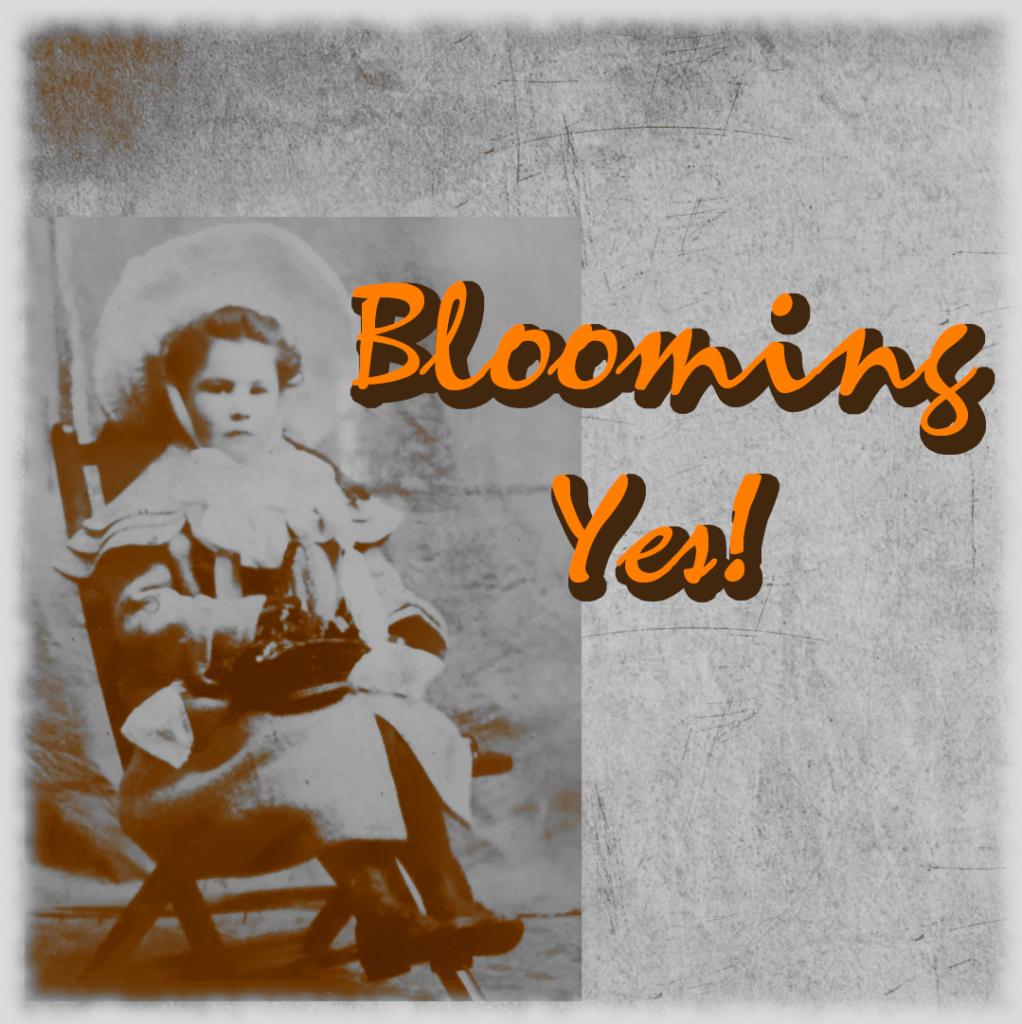
Blooming Yes!

My grandmother in Bloom’s time

Blooming Yes!

This is a strange one, a bonnie, bonnie strange one. Be warned, now is the time to avert your gaze, or plug up your ears. Be advised, we’re entering Joyce territory. God, but I’m going to feel really stupid reading this blog.

You see, Bloom’s Day is upon us, ‘Yes, Yes, Yes!’ Or maybe no, not for you. Perhaps you are one of those who refuse a breakfast of devilled kidneys, not because veganism is the latest short cut to enlightenment, but because you can imagine that the lingering taste of urine, hinted at by Joyce, haunts kidneys you might otherwise enjoy. Ulysses and urine, there is so much of the stuff one wonders if Myopic Jimmy is taking the piss. Allegedly, James Joyce’s masterpiece is full of humour, but ask yourself who these critics are before agreeing with them.

First, I must say that this blog is prompted by my mother’s reaction to RTE’s promotion of all things Bloom, no, not the annual flower show in the Phoenix Park, Bloom as in Ulysses. Our national broadcaster is obsessed by the work. The D4 crowd are so taken by it that they believe Molly’s famous potty-sex monologue is a perfect marmalade and toast accompaniment. Thankfully, the yes, yes, yesing in the background never seems to penetrate my morning mind-fug. The advertisements would go unnoticed, pass me by, as though they were news headlines, except that they wake up the critic in my mother. RTE’s harmless potty-sex fetish, no doubt a tonic to Joyce scholars everywhere, makes this one-hundred-year-old book, or its promotion, a problem for me. You see, just a snippet of the monologue can irritate my mother for hours on end. And she shares her irritations with me, which is why I’m writing this blog. This is a stress relief exercise on my part, one which should keep me sane until the 16th of June has passed.

“Doggerel,” is often my mother’s, pre-nine a.m. opening gambit. And she is not criticising me for a change. “I heard someone call that book poetry, but another critic said his poetry is pure doggerel. Not a poetic bone in his body. You can’t have it both ways.”

My mother likes the romantics, so I stay dumb by way of keeping my head attached to my shoulders. As the add rumble on she becomes even more annoyed.

“Nothing more than an alcoholic.” She tells me, “And as for that Nora Barnacle, her ignorance probably made him feel big about himself.”

“Would you prefer them to be promoting a reading of ‘Normal People’?” I ask by way of distraction. “They say she’s the new Joyce.”

In fairness my mother will not be distracted, so I get an extra ten minutes of criticism on Joyce.

Reflecting on her comments and sometimes comparing Ulysses, in my own head, to ‘Normal People,’ (yes I realise that this is a ridiculous activity,) I had a sudden, Eureka moment. You should never listen to critics; you will find life much more enjoyable without looking over your shoulder to see if they are watching before allowing yourself pick up an Agatha Christie. Having said that, here is something you might want to bring to Joyce’s masterpiece.

Joyce is nothing more than an intellectual Benny Hill, a man with a urine fixation, a purveyor of bum jokes disguised as literature. A man of his times in fact, a time when you had to make your own fun, when neighbours were for laughing at and bodily waste-fluids were stored under your bed at night. Stepping in dog do-do was a cause for laughter among friends and, as for falling on your bum, that caused hilarity all round for months on end.

My grandmother was born at practically the same time that the Bloom’s Dublin odyssey took place. For most people, this was a time of outdoor plumbing, with chamber pots serving as primitive ensuites. Say what you will about them, squatting over one every night was a great form of granny yoga, a way to keep the old supple enough to function on a daily basis. Fancy potties were decorative to the point of competing with Ming dynasty vases, tin sufficed for poorer bums. It was a time when limps, squints, and stammers were openly mocked, and as far myopic young lads were concerned, they were the joke.

My grandmother and her friends were all practical jokers and none of them would have needed to read Joyce to improve their minds. Their minds were active enough already and their neuroses formed the foundations of their individuality. Potties would have featured in all of their lives. But they would never have considered writing a doctorate paper on the symbolic significance of Molly straddling one. There were other, more humorous uses for the potty in their lives. My grandmother, about the time Joyce was presenting Ulysses to the world, came up with a novel use for the chamber pot. This was a new pot, I hasten to add, a decorative one. My grandmother was having guests to dinner, and this was a special occasion. The food was good, it was always good where my grandparents were concerned. My grandmother made her famous onion soup (as served in her restaurant) and poured it into her tureen for the day. She then walked into the dining room, placed her new chamber pot on the table and invited everyone to present their bowls.

As gags go, I’ve seen worse.

As writers go, Joyce would miss the cut on my comic writers list. But at least a woman on a potty, scratching an itch, and screaming yes into the night is a positive scene. Molly knows what she wants and does something about it. Yes, she does. Yes, yes, she does.

The millennial tale Normal People might be considered a masterpiece by many, but I ask you, where is the fun in the work?

Imagine a millennial style sex scene in Ulysses: Bloom enters Molly’s chamber late at night, drunk but standing, he tells her to get off the piss pot. This might be the conversation which follows.

Molly:             “Do you want to fuck me?”

Bloom:            “Yes.”

Molly:             “I want to fuck you too.”

Bloom:            “We will need each other’s written consent first.”

Molly:             “Yes.”

Bloom:            “And have to get naked.”

Molly:             “Yes.”

Bloom:            “And to…”

Molly:             “Yes”

Bloom:            “And…”

Molly:             “Yes.”

Bloom:            “And an orgasm?”

Molly:             “No. No. No… Not for me. For you maybe, but not for me. For me sex and disappointment must forever remain linked.”

Would Molly ever dream of being so drearily normal? Maybe Joyce is not a lost cause after all. Still, I will never convince my mother to change her mind on the subject. Nor would I want to. And as Bloom’s Day approaches I can not imagine my mother incanting the words, yes, yes yes: unless, of course, she discovers a free, wheelchair parking place at the steps to the library.

Categories
At Home With Memories and Reflections The Guy With The Hand

Fish & Tips

Friday mornings, I go shopping with my mother, whether this is an ordeal or a pleasure I have never quite decided. The ordeal begins, oops. Anyway, before the shopping can begin, the wheelchair parking badge must be removed from my mother’s car and displayed in mine. This badge warrants a blog of its own, let’s just say that at 93 years of age my mother has finally been granted a wheelchair parking permit. The downside to this is that, although there may be many car parking spaces available in the car park, I must take on Friday’s inevitably chaotic traffic and do a drive by of the wheelchair parking spaces close to the supermarket’s entrance. Only after we are certain that they are full, and that nobody is leaving any time soon, am I allowed to park elsewhere.

We don’t shop in one of the multiples, but the store is relatively large, well-stocked, and the staff are pleasant. One advantage of the store is that there are more than a few grey-haired clients who are all as regular as my mother in visiting it on a Friday. This means that it can take some time to get around the supermarket, no matter how small our shop. There are many hellos to be made, inquiries about hips and cataracts to be satisfied and news of funerals missed and discussions about mass cards to be sent. Some people may call this gossip, however, for me, gossip always entails the invention of salacious facts, so I just think of this as a community news event. After topping-up on the news front, we head to the farmers’ market, which is only about 500 yards away, though this involves a drive past another couple of occupied, wheelchair parking spaces. The market is hidden as far away from the public as the County Council could make it, without taking steps to ban it outright. And it varies in size, depending on the season and the weather, but you can always rely on at least seven regular stallholders being in attendance.

The irregulars may very well sell the best homemade chocolates around, but they tend to be fair weather hawkers. There are experienced knick-knack sellers who occasionally turn up, but the County Council site does not offer the exposure they need, the footfall required, to make a profit, so they quickly depart to busier pastures. This footfall issue is a pity, because local would-be entrepreneurs open and close-up-shop on a regular basis, never getting a real chance to properly test their stall’s full potential. Meanwhile, some people do surprisingly well. All last summer we had an exotic regular, a poet selling his wares, three books of his own poems, but he disappeared for the winter, presumably there is only so much suffering a poet should have to undergo for his art.

Of the regular stalls, three offer homemade baking, jams, honey, and eggs. There is a cheese stall too, where many of the cheeses are made by the stall’s owner. There are also two vegetable stalls, one primarily selling homegrown vegetables, direct from the stall owner’s land. But for the purposes of this blog today, I’m going to concentrate on the fish van.

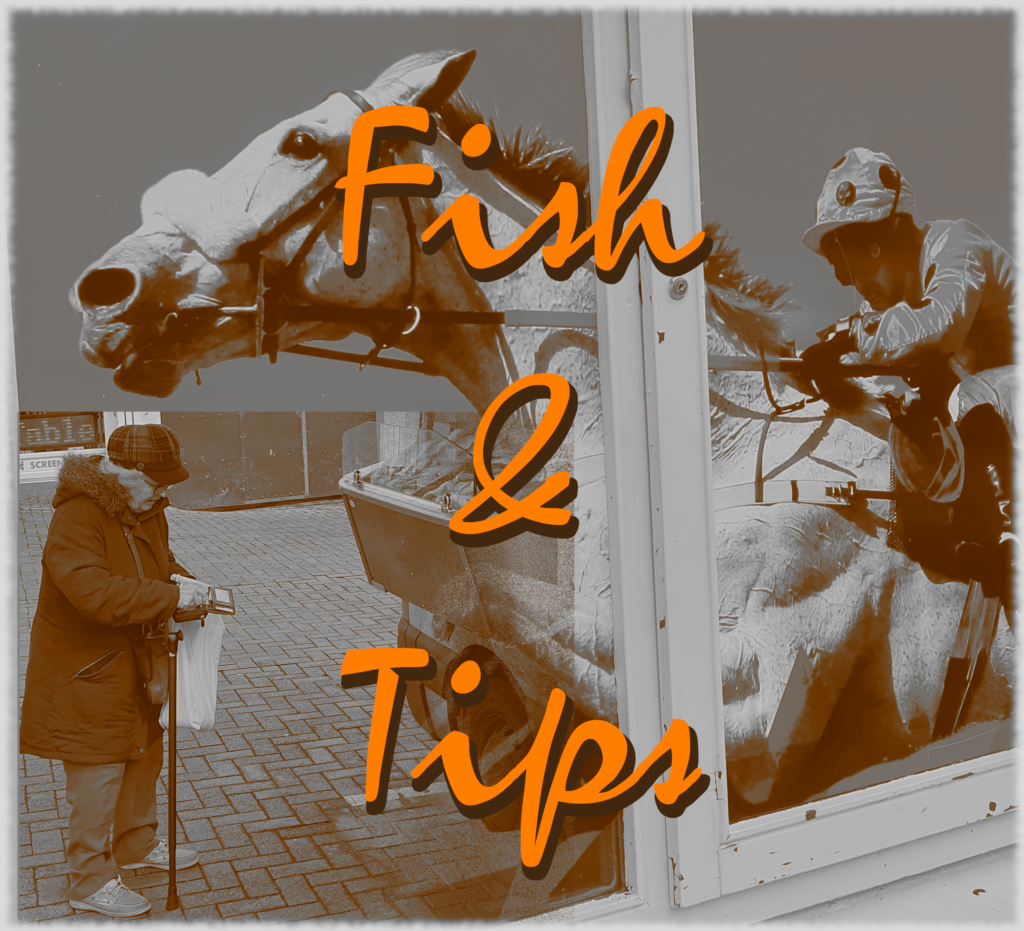
Jason is known far-and-wide (according to himself,) as the Fish & Tip man. Though, in reality, he should be known as the Fish & Banter Man because, as well as trucking in fresh fish from Wexford every Friday, he always has an endless supply of chat, cooking advice, and jokes at the ready for customers. For many, he is the market’s main attraction. And many of those would never be caught dead in a betting shop. Jason, you see, is a passionate horseman, and like all passionate people, he loves to spread the news.

His stall is our first stop every week. We may need bread, or jam, or honey, but not until we have secured our bet for the day.  Even if there is a queue ahead of us, we get in line. My mother invariably rumbles through her bag to find her notebook well before we reach the counter. There may be the name of a book, here or there among its tiny pages, perhaps even a telephone number, but a quick flick through it would make you think it is the form page from a newspaper. There are times noted, venues recorded, and the most exotic of equine names carefully written down in my mother’s elegant hand. The odds are never noted, starting prices only come into play later. Many of these horses proved to be also rans, but the winning side of the ledger favors my mother.  Ma has pen in hand and notebook at the ready by the time the man ahead of us has bought a lobster, filled a bag full of prawns and has decided between the salmon and the hake. Then it is our turn.

“I have one for you today,” Jason normally says to my mother, before turning to me and asking what fish we want. Once I have given him my order and he is fulfilling it, he talks to my mother, takes out his phone, calls out the name of a racecourse, the race time, and the horse’s name.

The people around us normally are intrigued by the events unfolding before them. Some see my mother and smile, thinking poor, wee, lost, old woman. Some frown, wondering what they’re missing out on. An old friend, who was behind my mother last week, asked her to place a tenner each way on the tip of the day. Sometimes, you can even see a person’s lips move as they try to remember the name of the horse, intending, no doubt, to check it out later.

The funny thing is that my mother is still on the winning side of the Ledger this year. But the horse from the week before last was not even placed. This may be the reason why Jason felt a little bit shy about offering my mother a tip on Friday morning. However, he was determined to do well by her, and asked her to text him later, he most certainly would have a winner today. I entered his telephone number into my mother’s phone, texted him using her name, asking him for her tip for the week. The horse won. It makes up for the winner we missed out on, on Good Friday. The tip was good, you understand, but the bookie was closed. Still, the fish was delicious.

Jason texted us the good news last Friday, confirming the win only minutes after the race was run. Now, that is some service. And the winnings more that covered the price of the hake, the monkfish and even the bag of crabmeat we bought.

Categories
At Home With The Writer's Desk

Giving Voice To A Blog

My Recording Studio

When most people think writer, they imagine hands hovering over keyboards, they see eyes staring, unblinkingly, at a rapidly moving cursor. They visualise coffee stains on an Ikea desk, or nicotine-yellowed fingers pawing helplessly through notebooks for a forgotten phrase, or an idea in need of transcription. For those of you who have not sat there yourselves, staring at a blinking, stationary cursor, there may be romantic visions of high-backed chairs, behind opulent, antique desks which sit in expensively decorated offices. Others of you may conjure up a writer’s den which is a low-ceilinged, uncarpeted bedsit, with a miserable desk off to one side, and an unkempt bed pressed hard against an unpainted wall.

Few of you would imagine the writer as a bald, sixty-something crowded into an airing cupboard, reading his blog from a laptop which is balanced precariously on a mountain of freshly laundered underwear.

A microphone stands before him, mute and accusatory. It seems alive and takes the place of all the sarcastic teachers who ever berated him as a child for stammering over uninspired textbooks.       

You may remember that feeling, the panic which spread through you as you counted-off heads and sentences in an effort to find the one you would have to read out loud to the inmates who make up the rest of your class. While you found your reading, other junior scholars opened mouths and stumbled through passages and your index finger turned white, bloodless as it ran back and forth under the sentence you were destined to share. At moments like this you muttered the words to yourself, silently incanting them, prayer-like, in your head, in the vain hope of memorising them. Finally, you were as ready as you anybody pumping toxic levels of adrenaline was ever going to be.

Everybody else’s readings had passed you by, the meaning of the text was lost to you, but you were prepared, or were you? Your name was called, your palms became hot puddles of sweat, and suddenly your tongue was tripping over words which were a deformed version of the incanted ones, a spell gone wrong. Your index finger flew backwards more often than forwards on the page, progress through your sentence was painfully slow, but you got to the end of it with minimal sarcastic shrapnel hitting you head-on. The full stop was reached, and you hung onto it like a drowning man might cling onto a life jacket after jumping from the Titanic, with little hope of long-term survival. Although there may have been icebergs to the left of you, icebergs to the right, you were alive, safe for now. That’s when your teacher invariably asked you to read the next sentence.

By the time I reached my teens, my phobia of reading out loud had reached its zenith. By now, I was fumbling my way through Latin, French and Irish texts, and no matter who the teacher was, or what the subject, everybody in the class was expected to contribute. The written word, itself, held no demons for me any longer. I spent many nights tucked up in bed with a good book, a reading lamp illuminating words which kept me awake into the early hours of the morning. However, once pressed to share the joy I normally took from this solitary practice, the old tongue-tied-ness regrouped. During English class, my contribution to the public reading of our prescribed novel was a stammering, incoherent, deconstruction of a brilliant text into its disjointed parts. Somehow a working engine seemed to be transformed into scrap metal as I read.  These readings can best be thought of as my contribution to dystopian storytelling at its best. The emotional scars ran deep. By the time I left school I was sworn off ever reading in public again, yet here I am, a mountain of clean linen behind me, a microphone before me and a script challenging me to a duel.

I first hit the un-mute button for my video work. A silent how-to on making apple jelly, or recovering a lampshade, sort of defeats the purpose of empowering others to follow suite. So, I wrote a script and set to work. The results have been hearteningly well received. Apple jelly fans are a passionate lot, lampshade lovers, less so, but very much more appreciative, in a quiet sort of way.

This podcast came about because people I knew preferred to listen to, rather than to read blogs. 

While writing was an obsessive-compulsive disorder in my case, reading them was something I was reluctant to do. There was little point. My bleatings would get lost in the wilderness that is cyber space as it competed with millions of other writers who vied for your attention. But others were adamant, which is why I am standing in a linen closet, talking to myself right now.

The reason I am here is that getting the sound from the writer’s lips to the listener’s ears is fraught with difficulties.

Some people believe that so long as they possess an I-Phone they hold the key to worldwide, podcast domination. They believe that the phone is a multi-media, Swiss army knife of sorts, capable of keeping you current on your twitter feeds, posting pictures on Instagram, or filming, and editing, award winning documentaries. Can there be any doubt that recording a podcast must be simplicity itself?

The answer is yes. Sound is a devious creature. Without proper acoustic dampening, a bedroom recording sounds like one made in the deepest, darkest cave ever discovered. It becomes an echo chamber where whatever you say reverberates for eternity, even if you use a proper microphone; one shielded from direct contact with the p sound, which left unguarded, hits the eardrum like an out of tune base drum.

Whenever I sit at my desk and type, the outside world makes itself heard. Birds spread the message that they ready to settle down with any mate eager enough to respond to their lusty warblings. The wind today is from the east, and every April shower that comes along announces itself by hammering against my window, making this room unsuitable for recording anything, other than a shopping list.

Anybody who has read my blog about my writer’s desk will remember that I am a guest in my mother’s home. She has the ultimate say on any changes which get done to her house. And she is a no-changes-to-my-house kind of a person. This is ok with me, but it means that improvisation is required, if I am to record anything which meets even the most basic audio standards.

This is why I record my podcasts in the hot press. It is the only room in the house without a window, which means that the winds can blow as hard as they like without rattling glass panes, and birds can have the most raucous of orgiastic feasts, and my mic shall remain deaf to their antics. The clothes, too, are useful, as the washed linens, piled high on shelves all around me, dampen reverb, and make this room the only echo free chamber the house has on offer.       

It is a strange feeling, though, standing before a microphone, script before me, underwear piled up high all around me, to read my work into a microphone in the hope of capturing something of the spark which tickled my imagination and brought me, willingly, to my writer’s desk with an urge to share these thoughts.

What drives me to splutter into the microphone, I cannot say. It is not an easy process. There is the problem of breath control. Really, an actor is more suited to this job than an author. A writer may hear voices as he writes, but that does not mean he can read them back to you as they were imagined. There are the coughing fits too, hay fever in no friend to a man locked in a hot press with a manuscript and a microphone. And what will people make of my voice? Is my accent off-putting? Perhaps it speaks of white privilege. Is it too male? To deep? Too squeaky? Body image may cause all sorts of neurosis, but when you are stuck with a voice recorder, watching audio levels rise and fall with your voice, in a stuffy little room, you can get well past neurosis and enter the gates of total funk.   

And if you supress that panic all the way to the end of the blog, the process is only half-way through. Now comes the edit. Your first opportunity to listen to messages from a linen closet. Only, now you get to see your voice as well as hear it. Waveforms appear before you and accuse you of whispering here, or shouting there. If you are like me, you cannot tell a lut from a decibel, so the screen you face is more like an art instillation than anything else. It seems deliberately obscure. But with the help of YouTube videos, you eventually have a file ready for podcast. Whether anybody will listen to your finished recording, is not really a question that bothers you. You have had your say. You have read every word of your blog without interruption, sarcasm, or laughter stopping you. You have given voice to the words on the page, sometimes, that is the only thing that matters.

Categories
At Home With Memories and Reflections

The Jump

According to my sisters, no Gemini should ever contemplate giving birth to a Pisces. Thankfully my mother ignored this advice, in the way she ignores most advice, not that her choices (many of which brought permanent frowns to the faces of the tut-tutting classes,) seem to have done her any real harm. As a result of such independent thinking, she failed to consult an astrologer before being so feckless as to conceive me. I am also fairly certain that she failed to consume folic acid as part of the baby having procedure. Folic acid was not in fashion back then. The harvesting of amniotic fluids would also have seemed barbarous science fiction to her generation, scans unnecessary and as to discovering the sex of the child before it was born, that would only have ruined the surprise. Remember, those were the times when naming a child before it was born was considered tempting fate.

So, she had a Pisces, poor thing, at least according to my sisters. Whether this is true sympathy for my mother, or some sort of accusation levelled against me, I cannot say. Suffice it to say, that according to them, it completely explains my mother’s relationship with me. What this is, is impossible to say, but according to my astrology hooked sisters, our relationship is fraught with confusion and misunderstanding. This may be so, but if it is, I explain it to myself as a generational gap, or personality differences. My sisters think otherwise. They tell me that we are merely actors in some Greek play; comedy, or tragedy they never say. Mostly, I ignore such talk, but sometimes I have cause to pause and wonder.

For instance, when my mother asked me to jump from an aeroplane, just what had she in mind? She had never, herself, expressed any desire to leap from a plane at five thousand feet and allow gravity do its worst. What was this about? Had her stars aligned her against me? Was the moon holding water? Was Neptune up to no good? Perhaps Mars was even redder than usual. Her request baffled me on so many levels.

My male role model, my father, was afraid of heights, enclosed spaces, being buried alive, and gardening (least it ruin his golf swing.) This may make him sound like a wuss, but he was no wuss, so long as his feet were firmly on low lying ground, and nobody was nailing him into a coffin while there was breath still left in his body.

However, he was generous with his neurosis, sharing them with anyone who would listen. Maybe because of this, I fancied that I too suffered from a fear of heights. Whatever the reason, when my mother went on a charity drive and asked me to jump from an aeroplane, for whatever cause she was supporting, I said yes. My theory being that, by facing my fears they would retreat to the side-lines and therefore be less of a nuisance.

It is all very well to sit on a barstool and indulge such a theory, but to turn up on a cold Spring morning as sheep are being herded from the runway tests one’s resolve. Seeing them ushered into a holding pen might have given me pause for thought but looking at the small aeroplane close to them was reassuring. Dowdy and humble sure, but it seemed airworthy. Just as this thought crossed my mind, a minibus pulled up beside it. Men got busy, jump leads were produced, an electrical umbilical cord was attached to the plane and my palms began to sweat, despite the cold. Still, I reasoned once the engine was started and up to speed… I shivered, gave up on reason and continued to the clubhouse. It is, after all, emotions, not reason, that drive people to greatness or their doom. My emotional investment was twofold, money had been raised for a good cause, backing down would have meant no money. There were also friends who had jumped before me. There would have been no end to the slagging if I turned and ran away now. I am sad to say I was driven by shame.     

I would like to say that the reason I was feeling fragile as fifteen first-time jumpers huddled together in a cold shed, was the early hour, however that is not true. My confidence had been lowered by what I had seen outside. Remember, these were solo jumps. We were not going to be conjoined with an instructor. We were going to have to find our own way down, though gravity would lend a helping hand, as our instructor pointed out when he stood before us and said,

“This is an adventure sport; people die doing it. Anybody who wants to leave, do so now.”

Heads turned; frightened eyes scanned the room for people brave enough to leave. But we were all cowards, more willing to jump from a small aircraft, than to look tiny in our friends’ eyes.

We then had a twenty-minute lecture about the joys of being splattered on tarmac, of having our legs broken, what to do if our parachute failed to open, and how to open our emergency shoots, as we dropped like a stone, when our main chutes failed. Fifteen sets of ears listened, and some brains may have absorbed the information. However, having teaching experience, I would imagine that at least five of those present heard nothing above the, ‘What-the-hell-am-I-doing-here,’ voices screaming in their heads.

You may wonder why I was still willing to go through with the jump, aside from the shame of dropping out. The answer is that everyone I knew who parachuted from a plane had survived uninjured. In other words, the technology was proven. I also remembered an evening spent with a one-armed golfer as he reminisced about being in a parachute regiment during the second world war. His scariest jump, he told me, was from a balloon basket. It was a straight fall, as opposed to jumping from a plane at one hundred miles an hour. Which means that you are moving one hundred miles an hour sideways as gravity takes hold of you and begins to pull you down to earth. The balloon jump was even scarier, he believed, than a night-time leap into the darkness. Based on his opinions, I would be pumping less adrenaline than if I were jumping from a basket.

Eventually, after learning how not to break a leg when landing, how not to castrate myself with the parachute harness – by tightening the straps correctly – the instructor pulled me aside for the hand inspection. Hand might be over stating things, hook would be more accurate. He asked me to raise my hands to see if the hook was high enough to catch one of the toggles which steer the parachute. We agreed that the hook was up to the job, it was all systems go.

Lots were drawn, soon myself and the others of the long straw brigade were watching the first batch of jumpers huddle together in the aircraft. You could argue that it is better to get the ordeal over with quickly but be assured none of us lotto winners wanted to exchange places with any of the sardine-like creatures now squeezed into the plane. My heart practically bled for the jumper who would be first out of the aircraft, first to count to three, to wait for the chute to open and slow their descent.  

Finally, the aircraft was fully loaded with scared, novice jumpers. Our instructor issued last minute orders and was about to join his students when confusion arose in the ranks. People spilled from the plane and a protesting; would-be parachutist crawled from the bowels of the aircraft. White-faced, he removed his helmet and handed it to the instructor, who immediately turned and gave it to me. Likewise, I was handed the main chute, along with the emergency one and, with no time to think, slipped into the harness and tightened up the straps.

There was no time to consider whether Saturn had gone retrograde in my chart, or if the stars had decided that, like a Final Destination victim, it was my time to die horribly for cheating Death some time before. There were quite a few moments to choose from. Whatever the reason, it was time to jump. Worst of all, using the ‘last-in-first-out’ rule, it seemed as though there was a big number one written on my back, I was going to be the first person out of the plane.

The aircraft would, no doubt, have been comfortable enough if it had passenger seats, or a door. Aside from the pilot, nobody got a seat, a lesson Ryan Air could learn from. As if confirmation were needed about the number on my back, I found myself sitting in the doorframe, half-in-half-out of the aircraft, the instructor, a lead weight on my feet keeping me from tumbling from the plane at least until we were airborne.

There were a minimum number of pre-flight checks where the passengers were concerned. There were no airhostesses prattling unintelligibly about storing your possessions in the overhead lockers. All I heard was the shout from the instructor, “Keep your feet off those pedals.” That’s when I saw the terrified jumper sitting beside the pilot. There is no way of knowing what size his feet were but, clad in walking boots, they seemed enormous and perilously close to the pedals before him.

The engine roared into life. The plane rolled forward and gathered speed. I watched sheep droppings fly into the air as the plane raced towards a hedge at the end of the field. My imagination was dwelling on fireballs as my mind flew into nightmare mode. All I could think of, as my shoulder dug into the doorframe, were size 12 boots pawing at the controls, keeping us on the ground just a second too long. Oddly enough, I now thought that it would be safer to jump from the plane at five thousand feet, than to stay on board for the landing.     

There are things no novice jumper is ever prepared for as they take that leap of faith. The silence for one. Then the view. When you look down everything is flat. Two dimensional. Disorienting. You feel lost. You find yourself asking, where did that big X you were told to aim for get to? Then you find it. The chances of you landing near it are slim, but there is a feeling of triumph at having found it. There is no doubt in your mind that you won’t land in the same field as the big white letter which marks the spot. The odds are in your favour. It is a big field after all, but with the wind at your back…

Then you spot the twenty-thousand-volt power lines beneath you. It is time to panic. You frantically pull a toggle and, instead of turning in a different direction, you become a human spinning top. So, you ease off on the toggle and drift away from the cables only to find yourself about to straddle a barbed wire fence.

Now, if a harness can damage you digging into your crotch, what can a barbed wire fence do to you? It is far tougher than nylon after all and sharper too. This is a rough translation of the OMG thoughts which ran through my head seconds after my twenty-thousand-volt power line incident. Unasked for scenes flashed behind my eyes.

It seemed that an accident and emergency ward featured in my imminent future. Young nurses swarmed into my imagination, gathered around my trolley, and eyed up the damage. They were wide-eyed, their heads craning forward to better inspect my injuries; their eyes both horrified and fascinated in equal measure.  I could have spent all day in my imagination, watching them watching me, getting high on hospital smells, but thankfully my parachute training kicked in.

By now I was an old hand with the toggles. Not that I understood them, but they gave me an illusion of control. I pulled and prayed, missed the fence by a few yards as I landed safely. Who cared that this was the wrong field? I was finally down, my legs appeared to work, even if they were weak. It was time to stand up, look around, assess where I was and make my way back to the adjoining field. Somewhere in the back of my mind the there was only one question that needed answering, were the pubs open yet?  

I arrived home a little later than expected, and right on the legal drink/driving limit – they were much more generous back then. This is ok, Pisces are known to like their drink. And as for my Gemini mother, she was her usual smiling self as she greeted me at the doorway before waving goodbye and heading into the night. I was home safely, she had places to be, the world was back to normal.

It was only later that my sisters told me that my mother had rung them, wondering where I had gotten to. The sun had gone down, after all, and only the foolhardiest would parachute in the dark. It was reassuring to learn, that no matter how the stars aligned, my mother did wonder at the folly of throwing her Pisces son from a plane.

I gleaned one lesson from this ordeal. The next time somebody asks me to jump, I will ask ‘how high?’ before agreeing. As for my phobias. I still have a problem with heights. But that’s probably just vertigo.